
Four Seasons Kyoto: I Wasn't Expecting to Cry Here
This place makes you feel like you matter.
by KA's Experience Team
January through October
Best months to visit
June through September
Best time to book
January through October
Best months to visit
June through September
Best time to book
Reminder Set!
We'll notify you when it's the best time to book this destination.
Get reminded when it's time to book
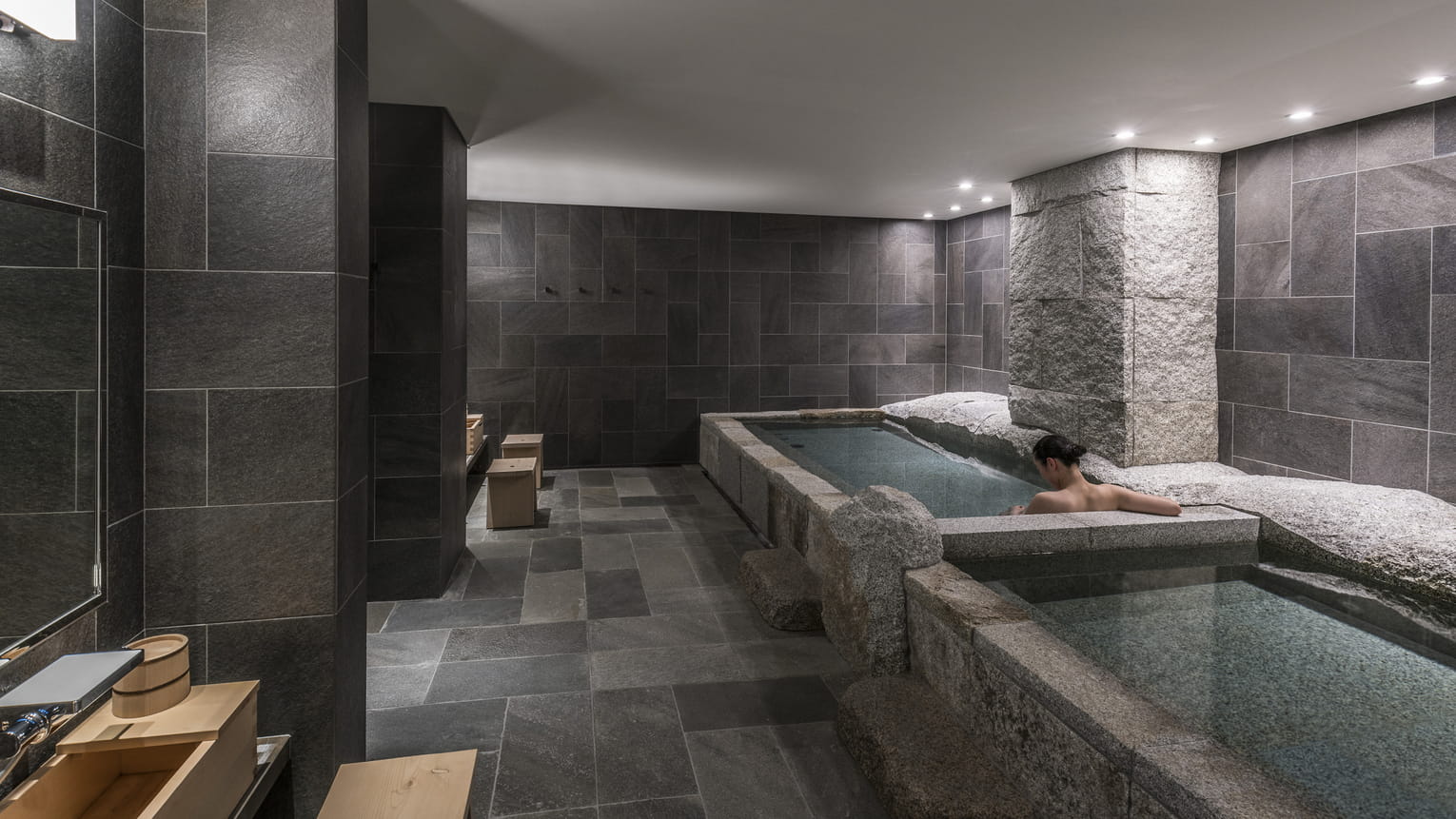
My first-hand review of Four Seasons Kyoto. The 800-year-old pond garden, five-course dinner that made us feel like the only guests in the restaurant, turndown service with details so thoughtful I still think about them, and an ofuro that left me renewed.
We Handle Everything. You Just Show Up.
No research. No coordination. No backup plans needed. Just your perfect journey—guaranteed.
Create Your JourneyI wasn’t expecting to cry or feel the way I did here.
Luxury hotels like Four Seasons give off polished, professional, manicured, a little too perfect, right? Everything works but nothing really moves you. That’s what some people think, anyway. I’ve heard people say that only a small or boutique property can have a soul and provoke real emotion.
Four Seasons Kyoto is not small. It’s huge, international, and part of a global brand. And yet, I was deeply moved.
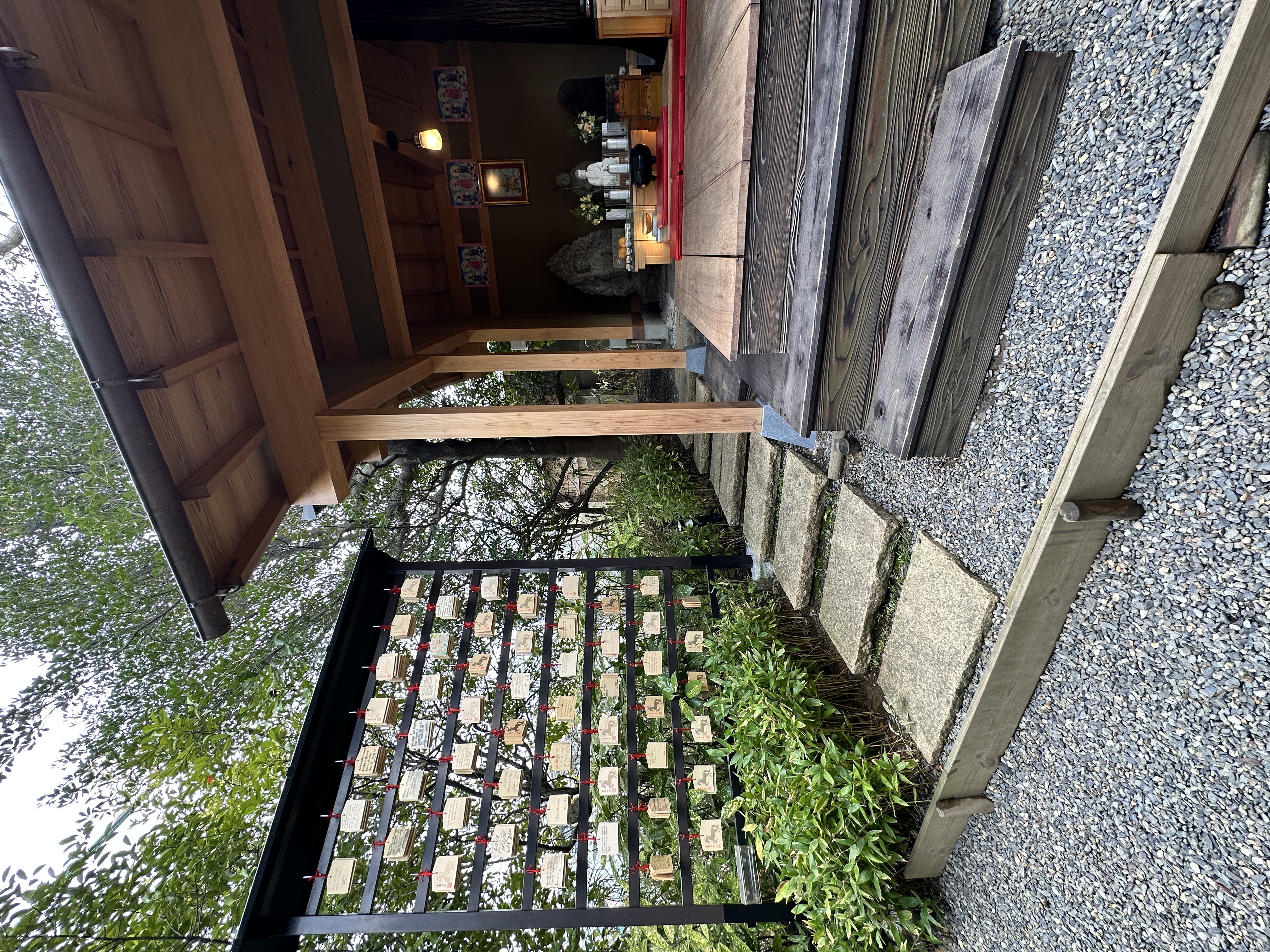
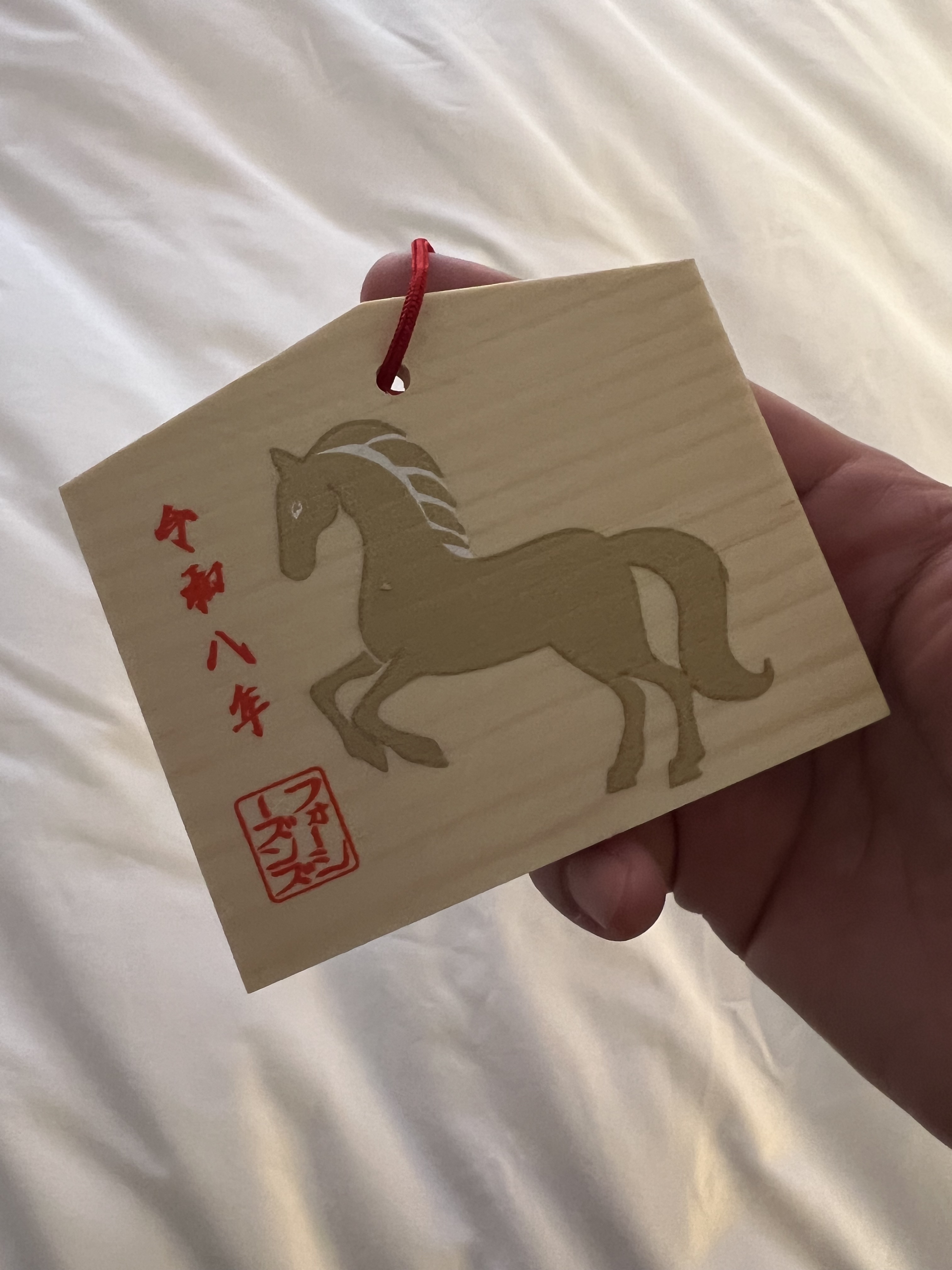
It was our last day and I was sitting on a wooden bench by a small shrine tucked up the hill above the pond. In my hands, I held an ema, a small wooden plaque where you write your wish. I had just finished writing mine. My wish was simple but profoundly personal. Israel, my husband, sat next to me further down the bench. I could see he was having his own moment. We embraced the silence and savored not needing to say anything.
I vividly remember tears softly rolling down my face and smudging the words on the ema as I wrote. These were not tears of sadness, but of gratitude.
For what? Well, let’s go back to the beginning…
They presented it to us the moment we arrived.
We had just arrived from Tokyo and were greeted with tea and these cute matcha cookies; delicate and subtly sweet. We looked around, taking it all in. It’s hard to describe because everything looks new, but it doesn’t look modern. It was like an elegant version of Kyoto. Subtle elegance.[14]
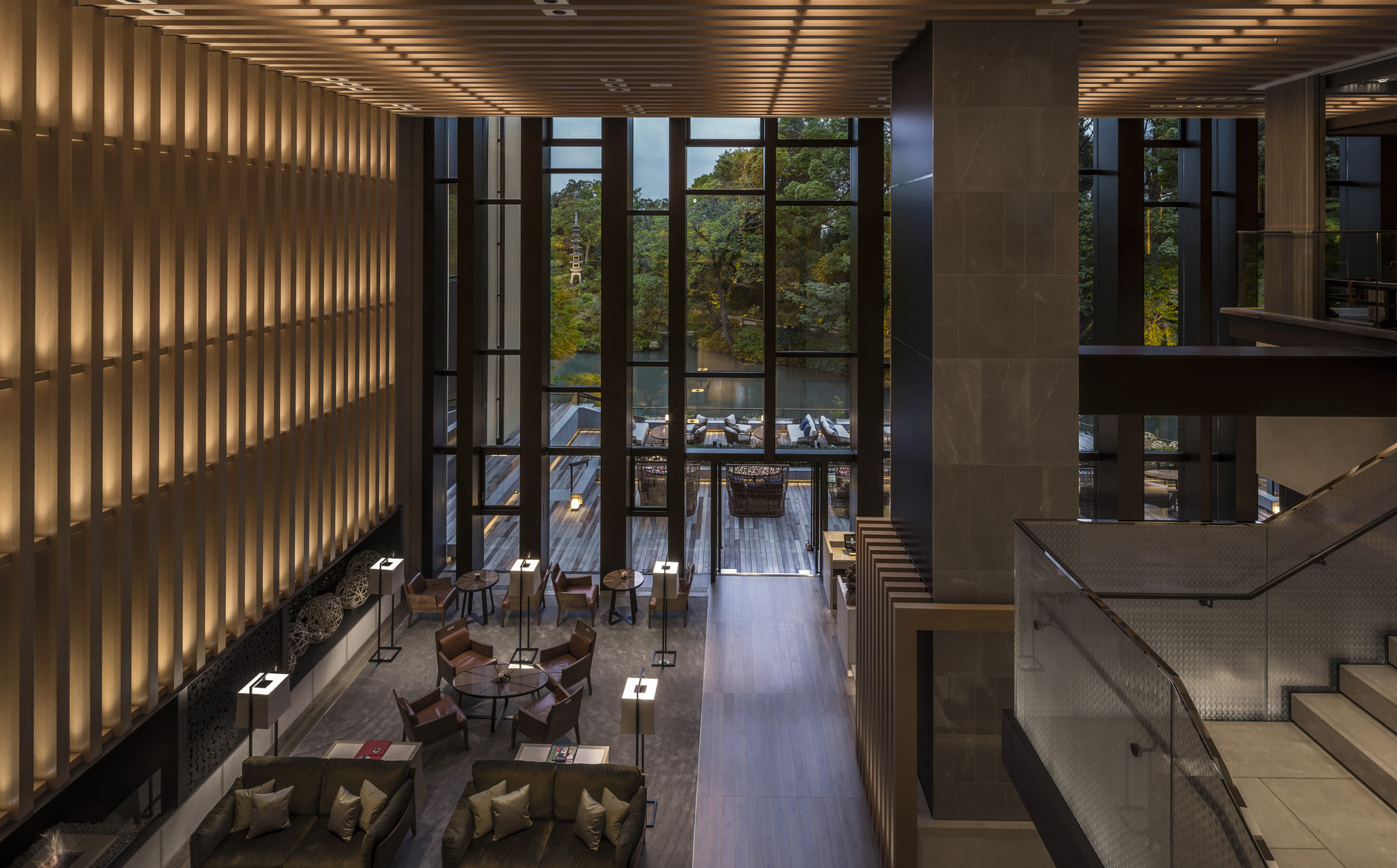
At the center of the lobby sat a large flower arrangement. Floor-to-ceiling windows in the near distance teased views of the pond. The atmosphere was tranquil but exciting, like there was much to do and I was eager to enjoy myself.
We met with Beatrice, who walked us down a quiet hallway. Along the way, windows appeared at unexpected moments, offering intimate glimpses of the garden and closer views of the pond. My eyes lit up and I remember feeling so happy.
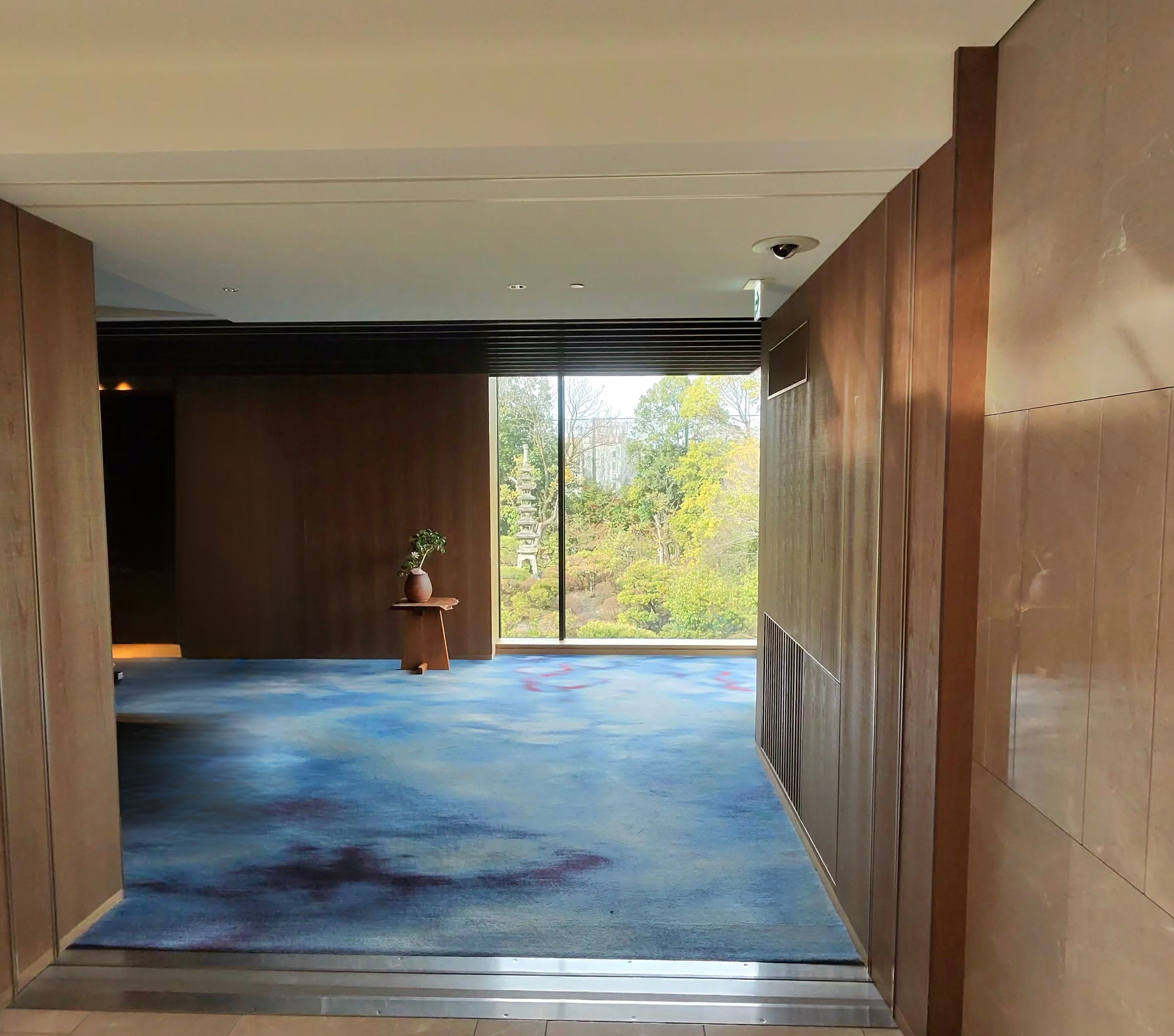
The window that appeared with a breathtaking view.
There’s a design principle that every tech engineer knows: progressive disclosure. Show just enough, let each reveal earn its weight. The experience here is a lot like that.[4]
The Room
Arriving at the door to our room, Beatrice handed us our room key. And it was one of the most gorgeous room keys I’d ever seen! Textured, with a green design that I’d later see echoed in the pillows and rugs. It was what I’m calling royally organic.
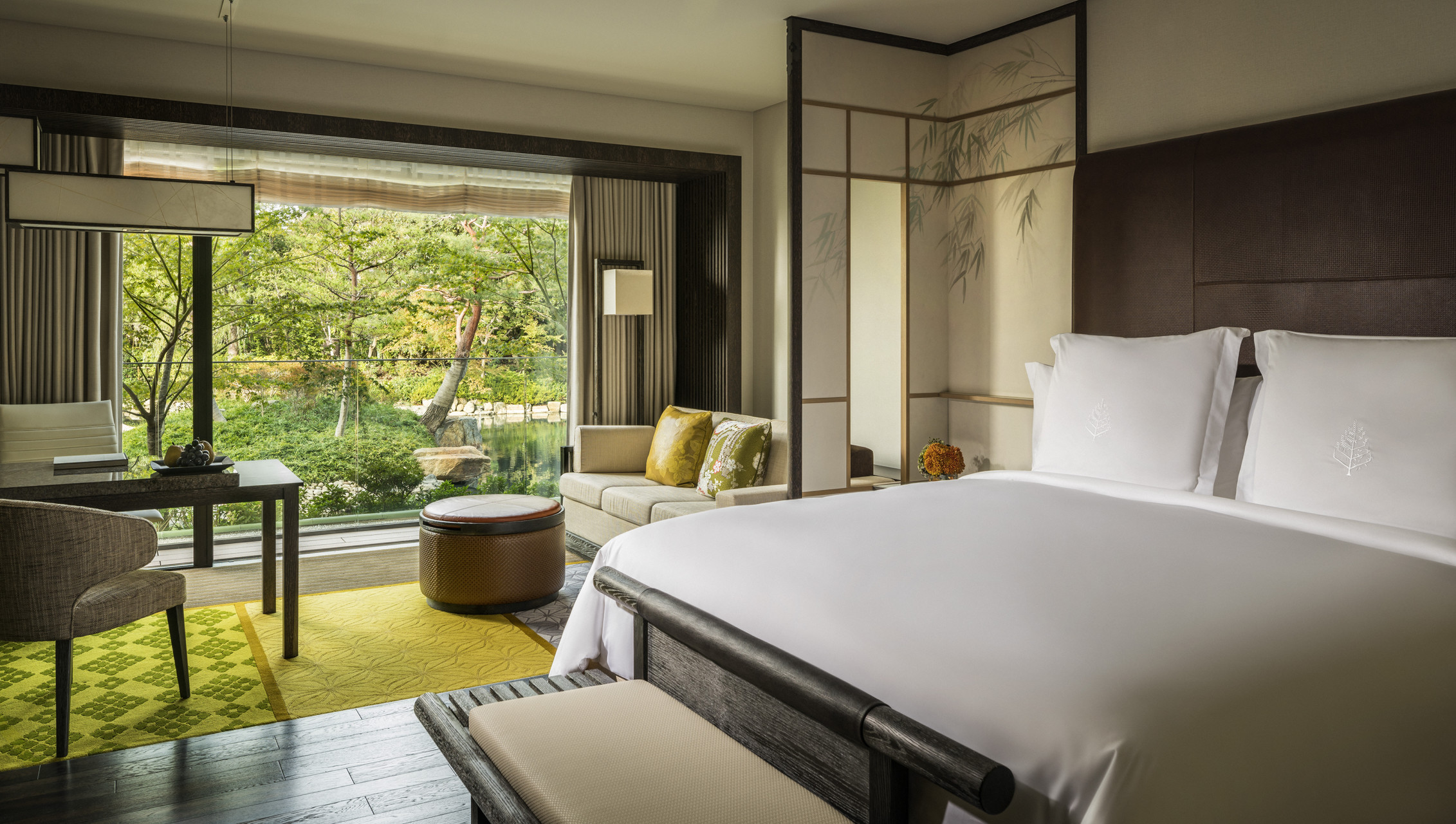
When we opened the door, I stopped short. “Woooow!” That’s all I could muster. They upgraded us from a Deluxe Room to the Premier Heritage Garden Room!
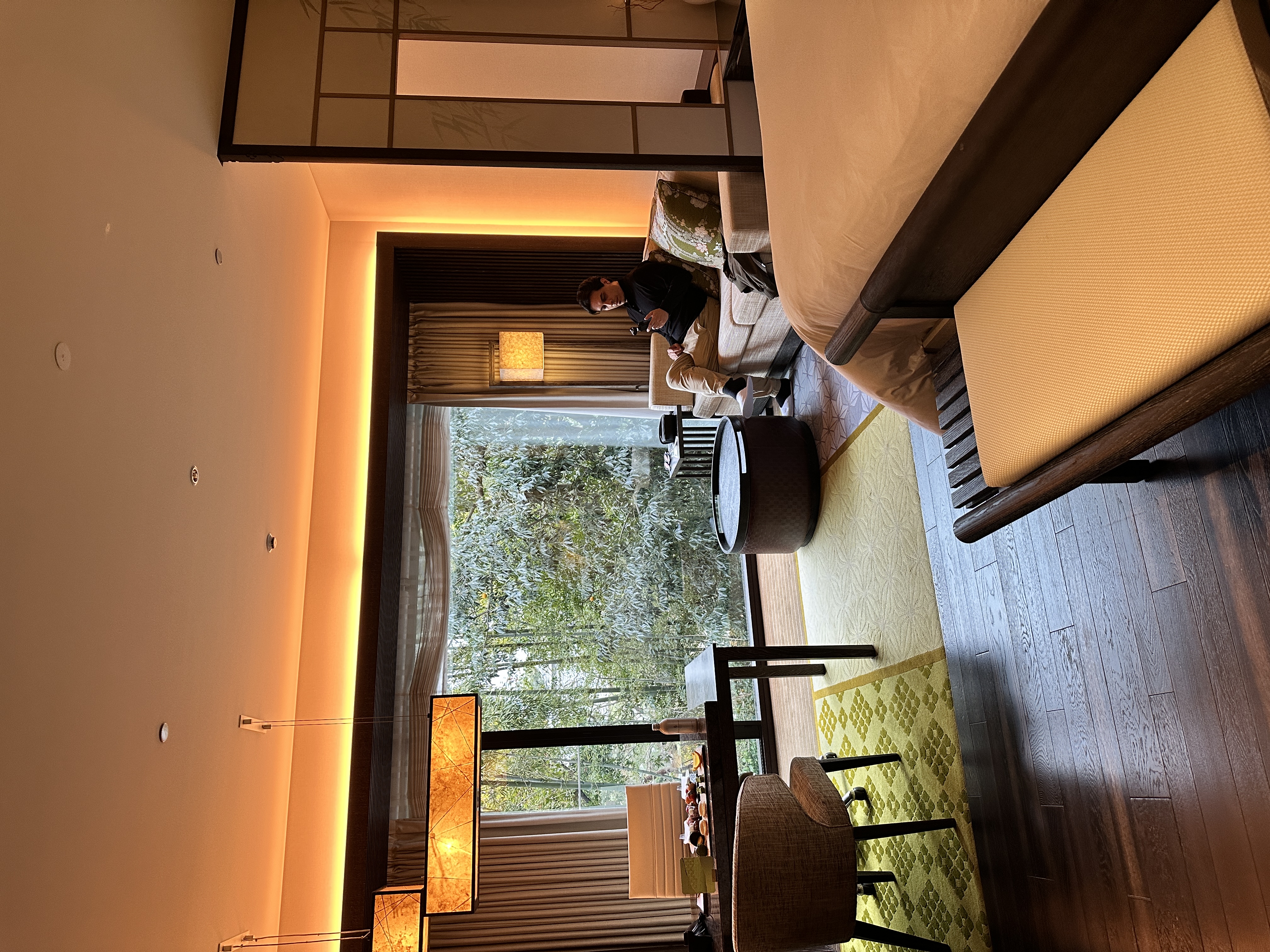
Israel, looking very at home in his slippers.
I saw tasteful bursts of rich green and gold everywhere. The windows offered views of bamboo trees and a small creek running through. On the table, an assortment of sweet treats from freshly picked to carefully crafted delicacies. And the STRAWBERRIES! There were three different kinds: deep red, lighter red, pale pink. Their scent filled the room and the texture was butter soft.
My gaze quickly found small squares of something bright green. Matcha, clearly, but I wasn’t sure what it was exactly.
I picked it up and took a bite. Oh my God!
It was creamy, silky, earthy and rich in a way that made me close my eyes. Pure euphoria. What was that? Chocolate? It did something to me. Israel looked over and smiled, “You okay?” I nodded and said, “Wow, that was spiritual!”
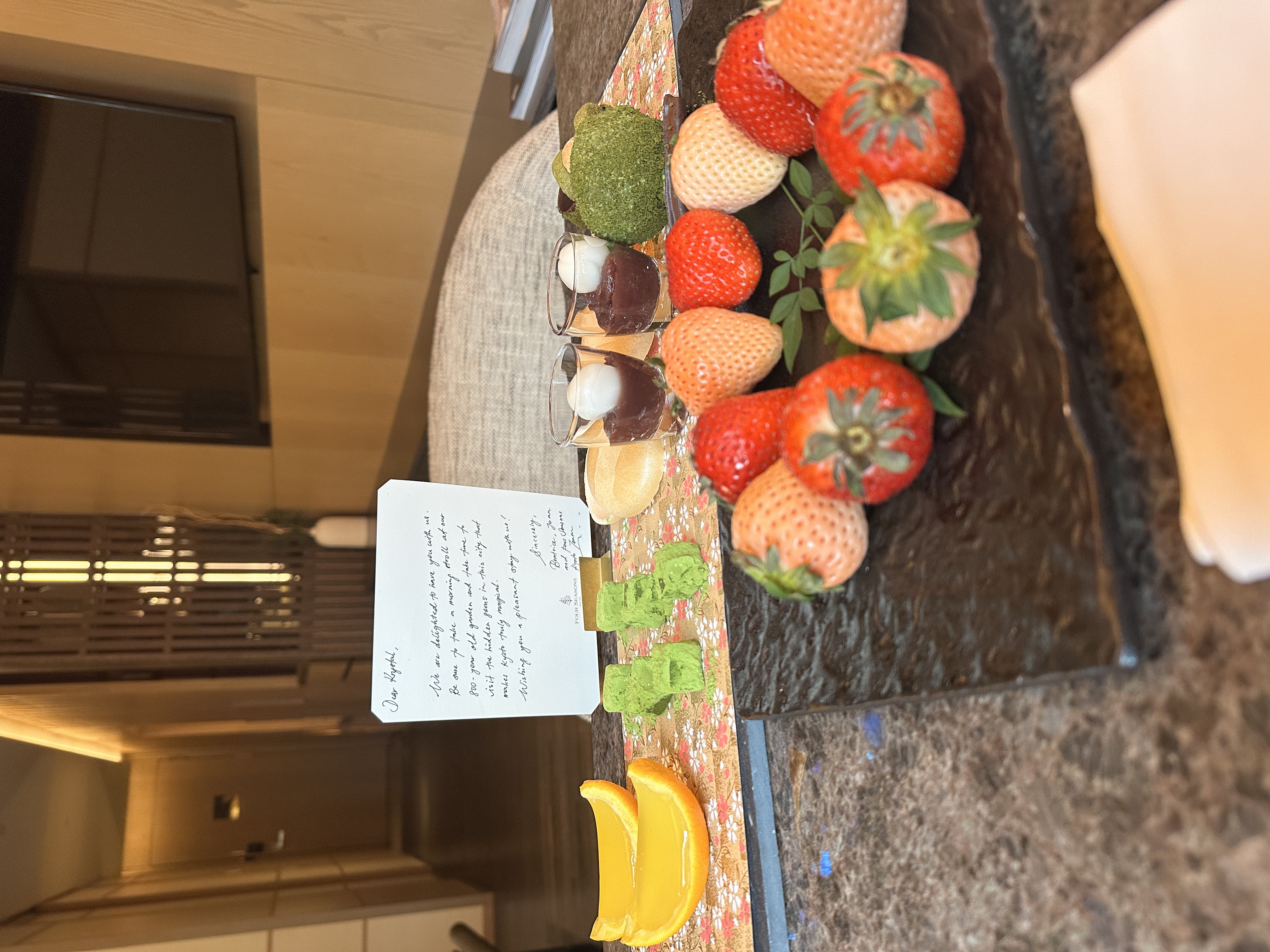
Three kinds of strawberries and that ambrosial matcha square.
The room was grand but quiet. Confident enough not to shout.
Everything had its own space. You could fully enjoy each area without feeling cramped. There was a proper desk where we could work, a lounge, and I loved the coffee, tea and water station.
The bathroom was so big! You could easily fit a rollaway bed in there. I opened a drawer that was slightly ajar; the hotel’s way of saying: look in here. Inside I found a wooden box packed with amenities: toothbrush, toothpaste, comb, and generously filled with anything you might have forgotten.
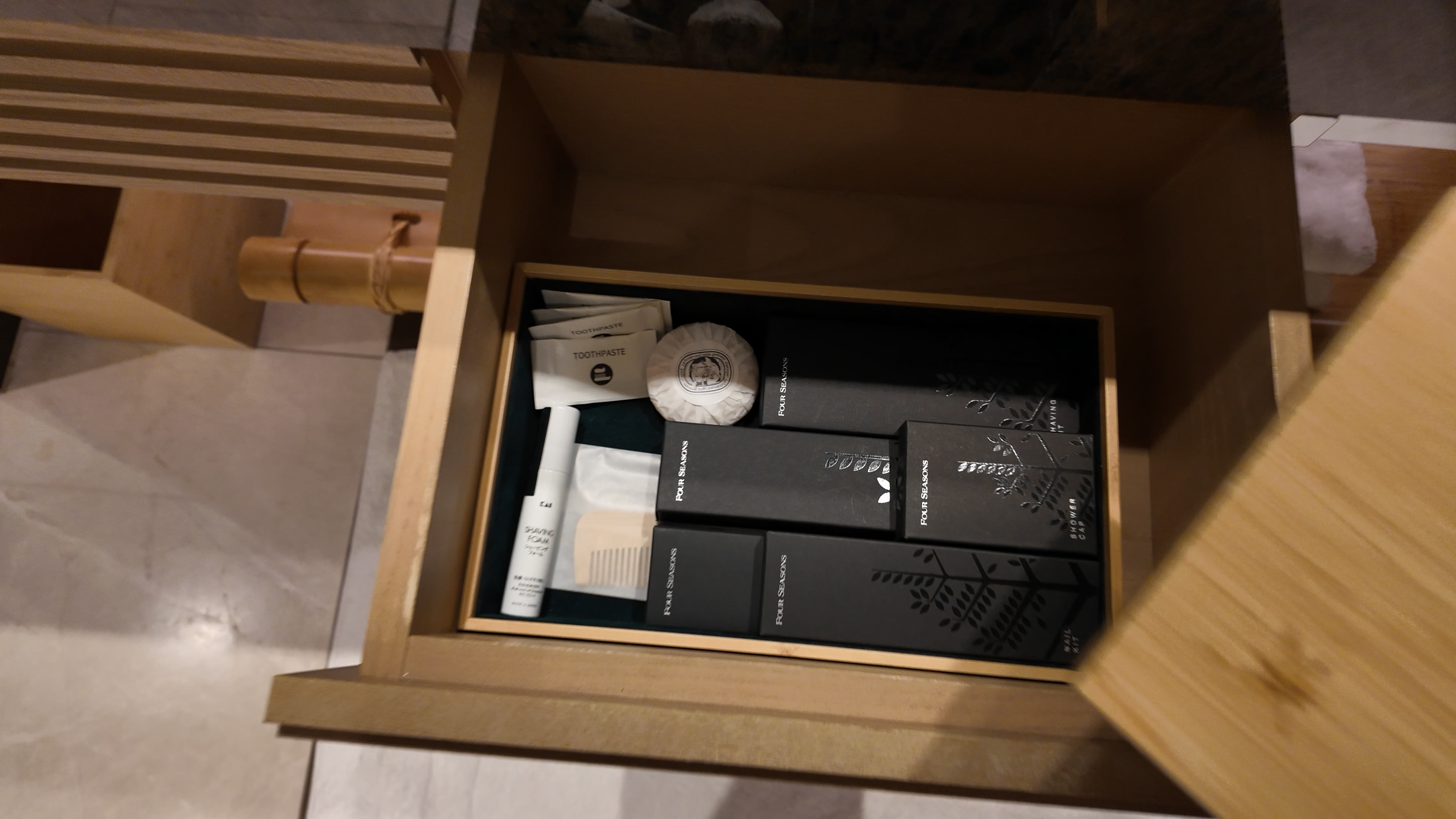
Loved the little toothpaste packets.
I looked up and there was a screen inside the mirror. You could watch the news or get inspiration on activities to do in the area while you got ready.
Then, Israel called out: “You need to see this toilet.”
I laughed. “What?”
“I’m serious. Come here.”
He was right. This toilet was next level! It had a bidet, a heated seat, and adjustable pressure. But what set this one apart from all the rest was that it had a dryer. A dryer, ok? I feel ridiculous making such a big deal about a toilet but the experience was that memorable. I miss it, and I may or may not have checked to see if I could buy one online. You can!
One last thing. There was a butler box built into the wall near the main door. If you need laundry done, shoes shined, anything, you leave it in the box and ring the bell. The butler collects it without ever entering your room, and returns it the same way. I never used it, but I found it very cool and convenient.
The Property Tour
About an hour after we settled in, Beatrice took me on a tour of the property.
They have residences here so we started with the two-bedroom tatami residence. It featured tatami flooring and futon-style bedding laid directly on the floor for a more authentic experience. I stood in the doorway and thought: next time.
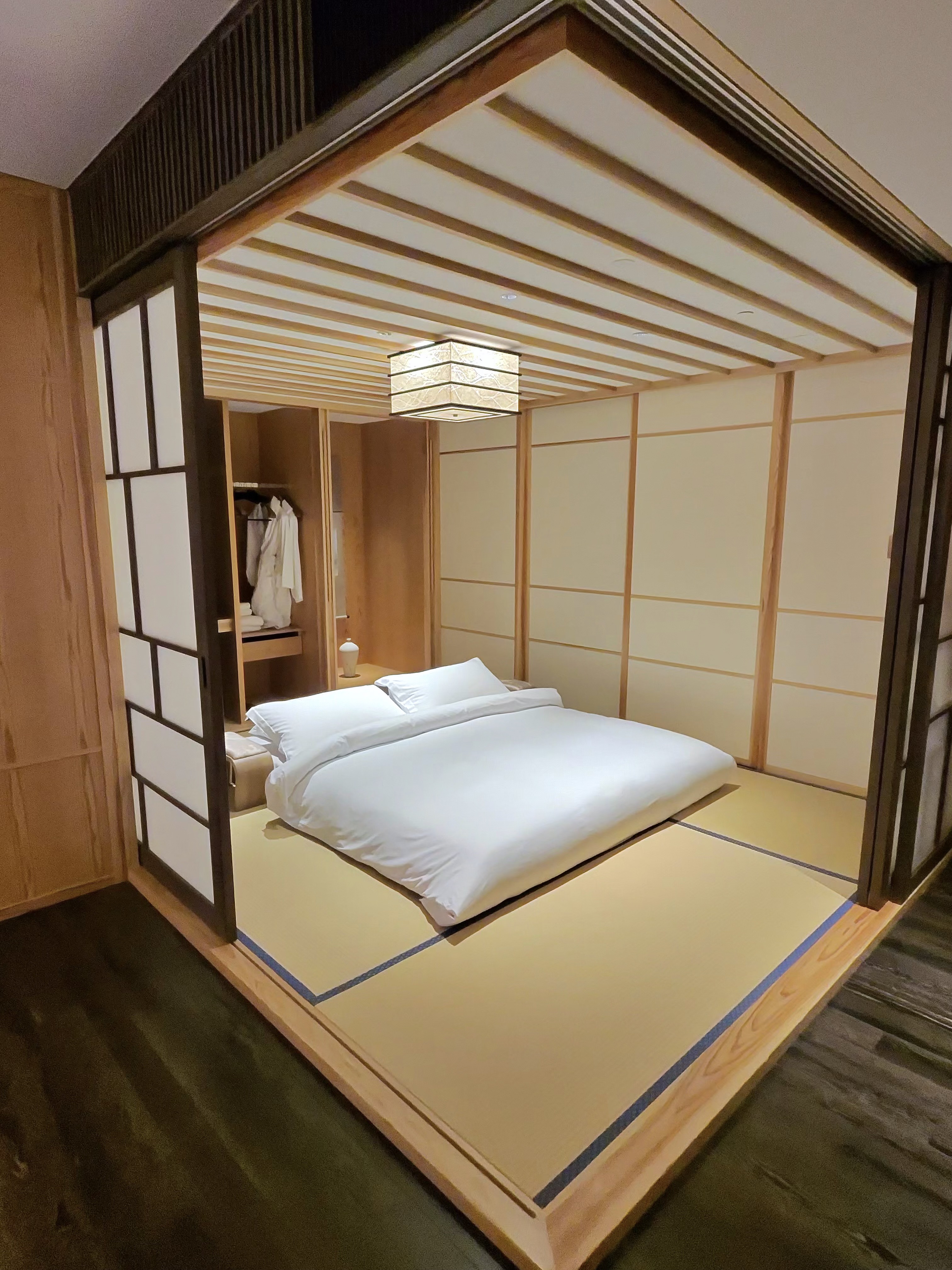
Isn't it beautiful?
Then, she took me to her favorite spot: the presidential suite. It’s the largest hotel suite in Kyoto.[3] I was especially captured by the art and detail on the walls. It only has two bedrooms but it feels much larger than that and the views are unreal. It’s like your own private home in Kyoto.
After touring the public areas, she let me peek into Sushi Ginza Onodera, the recently opened omakase restaurant on property. We didn’t dine there (I had another dinner planned), but I greeted the chef and marveled at the 400-year-old solid hinoki counter. Ingredients are flown in daily from Tokyo and Hokkaido.[10] There’s also a private room that you can request. I loved how intimate and hidden it was.
Definitely eating here on our next visit.
The Dinner
That night, we were invited to a special dinner at EMBA Kyoto Grill. They seated us at a table right by the window overlooking the garden. The light was starting to fade, and the pond looked almost black in the dusk.
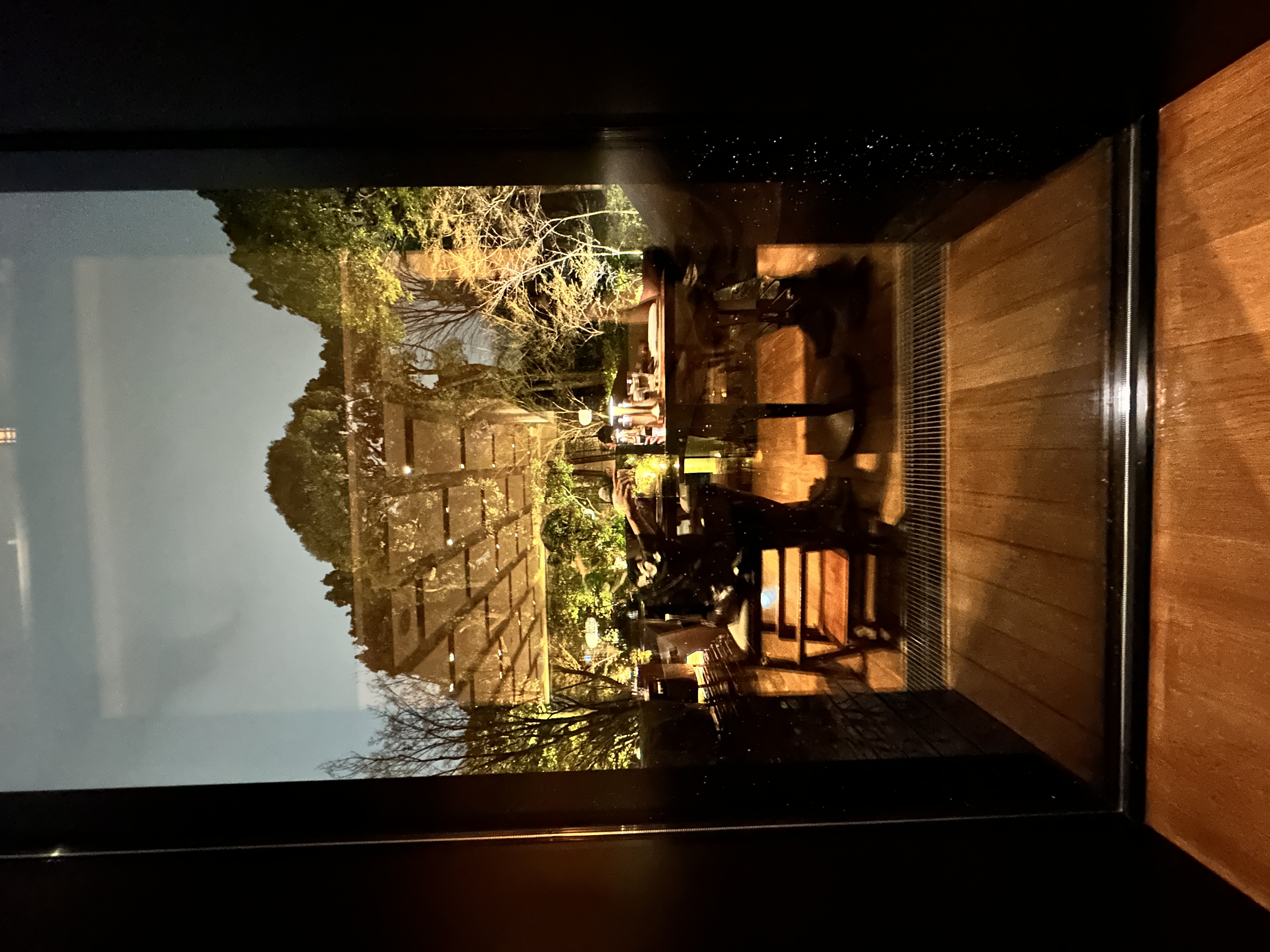
It's not crooked, it's wabi sabi.
Five different people came to check on us throughout the meal. Not in an overwhelming way, but friendly and attentive. One explained the dishes, another topped off our drinks, and others came by just to crack a joke or connect with us.
Each one of them added to our experience.
Can we talk about the placemats for a second? They were egg-shaped, with a grippy texture that held everything in place. I was fascinated by them!
The first course was Hyogo snow crab with caviar and fromage blanc. And this cheese foam. I don’t even know how to describe it except to say it was incredible. Light, creamy, rich without being heavy. It was delicious.
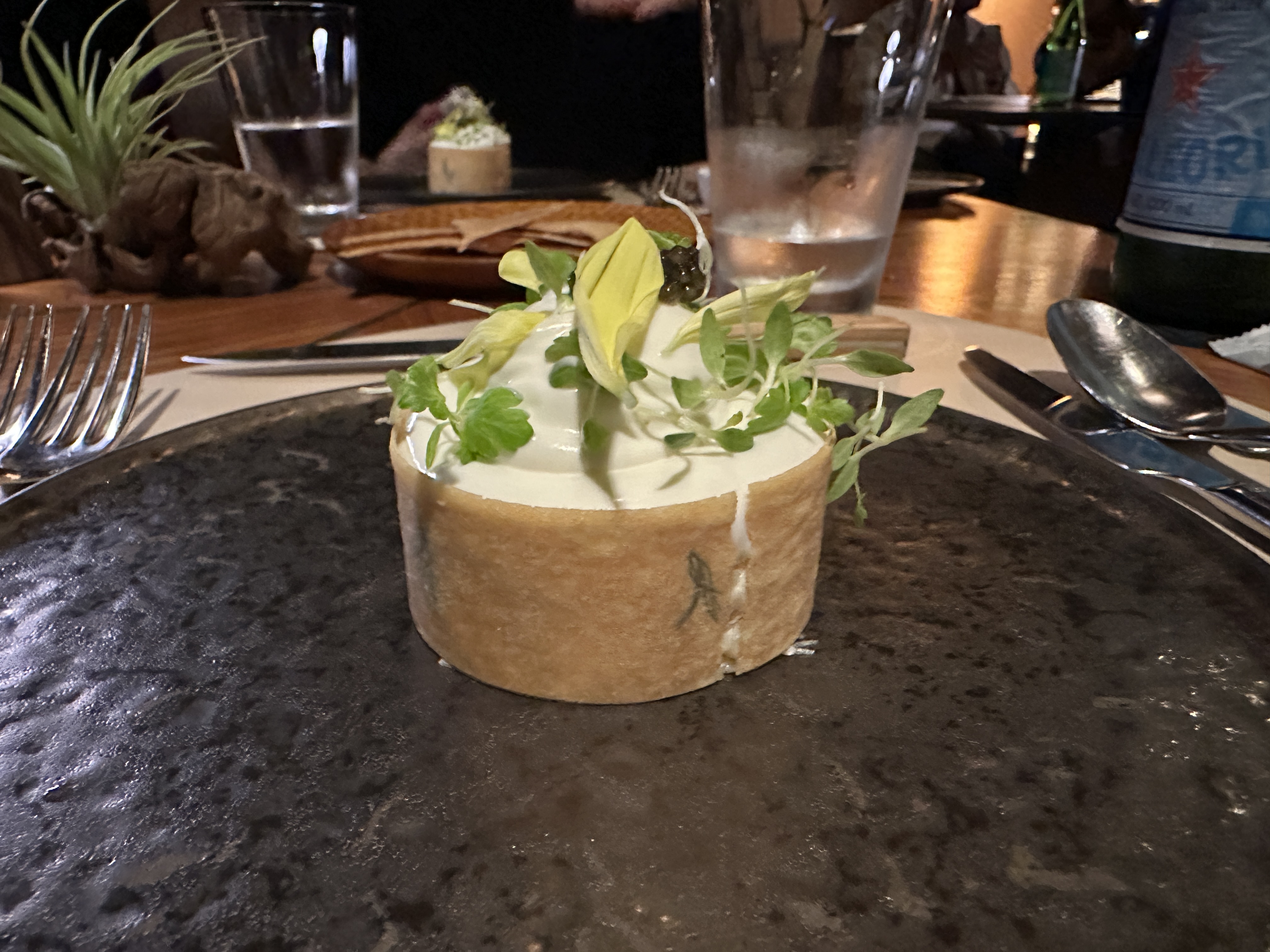
They had me at crab + cheese foam.
We were excited for the Hokkaido scallops; seared, with lobster sauce, cauliflower purée, sautéed spinach, pine nuts. It had been a while since I had a good scallop, and this one melted on my tongue.
But the beef. Oh dear lawd, the beef!
Charcoal-grilled Japanese beef tenderloin with shaved lotus root and smoked sunchoke. It was so tender, so buttery, I practiced mindfulness with every single bite. I didn’t want it to end.
For dessert, they brought out a strawberry vacherin. It was pink, colorful, and fun. I love desserts that are interactive. You had to break it to eat it, and that made me smile.
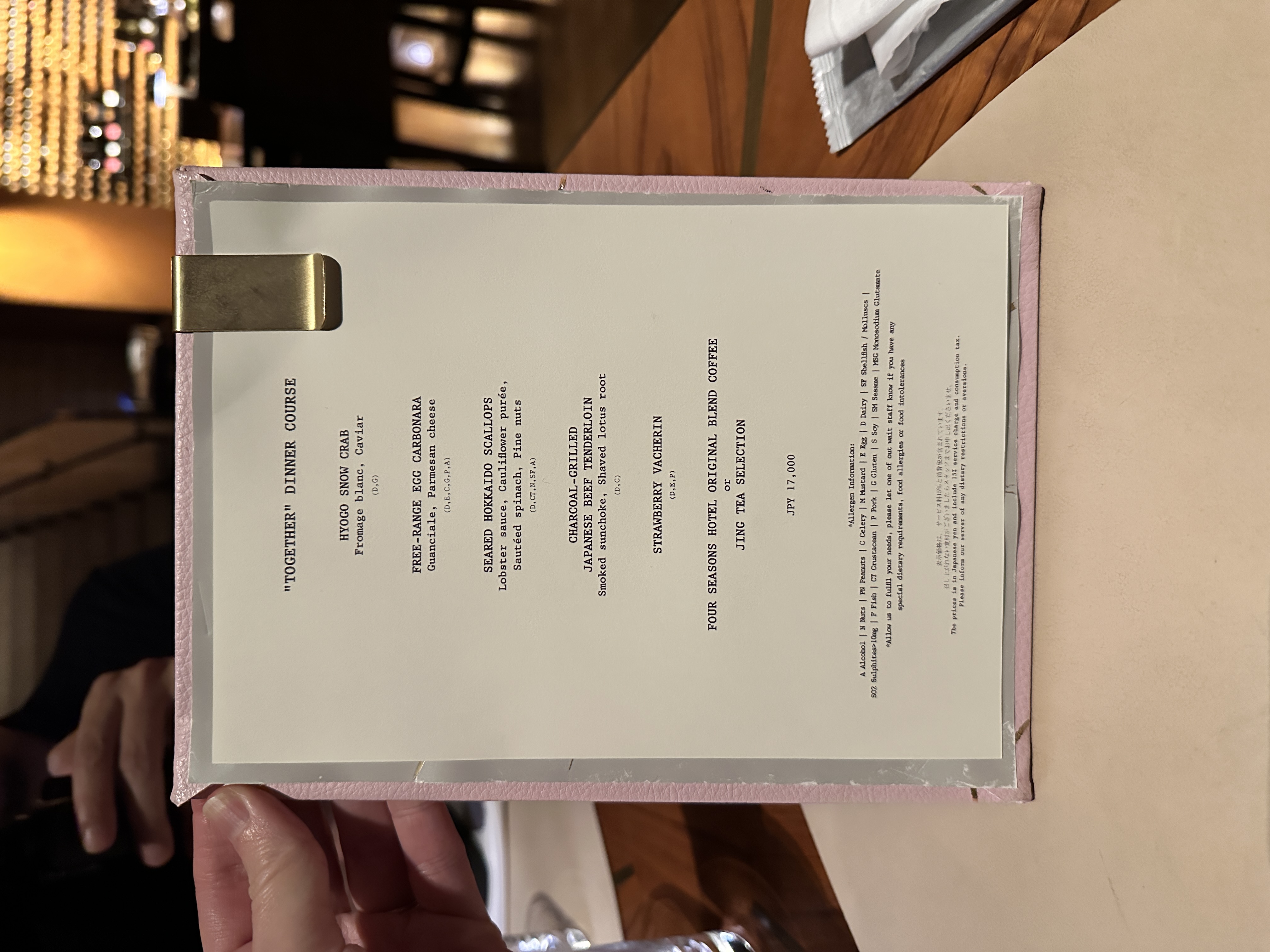
Romantically designed for 2.
By the end of the meal, we were so satisfied and so ready to head upstairs.
Coming Back to the Room
When we returned from dinner, I walked into the room and my eyes lit up again.
“Look!”
All of our charging cords: my laptop cord, my phone cord, Israel’s cords, had been wrapped neatly with these leather cable wrap embossed with the Four Seasons Kyoto logo.
“And my glasses!”
I’d left them on the table before dinner. They were now sitting on top of a beautiful cloth, a microfiber eyeglass cleaning cloth with an image of a maiko looking out at a river. It was also branded with the Four Seasons Kyoto logo.
I felt like a kid on Christmas morning. I kept finding all these little gifts and surprises they’d left us while we were gone.
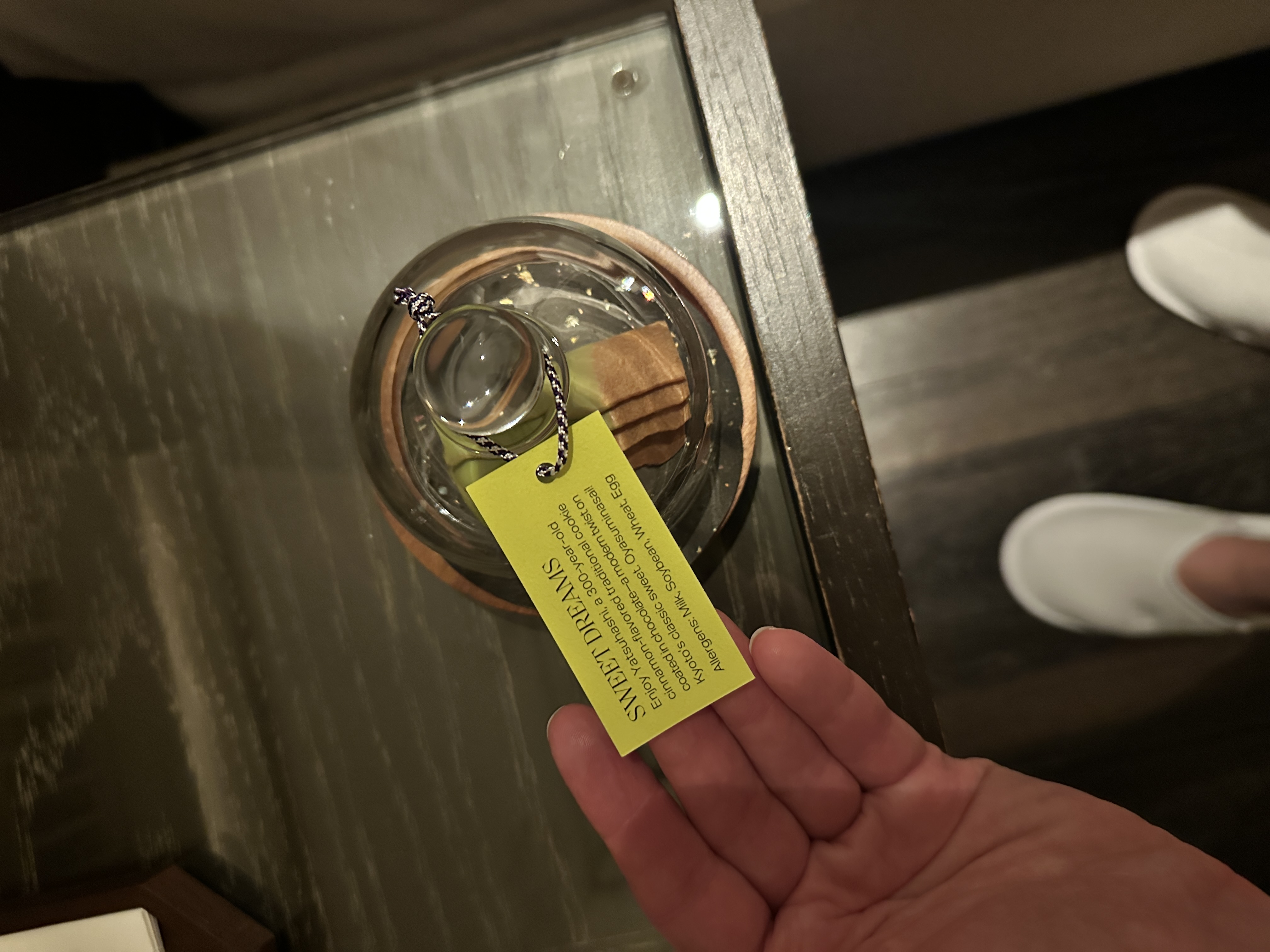
The only appropriate response was, kawaii!!
The lighting in the room had changed. The ice bucket had been filled with fresh ice. The shower cap I’d used was replaced with a new one. They placed small towels underneath our toiletries. And on the nightstand, they left a mini cloche with cinnamon cookies and a note.
I LOVED the notes! And there were little notes everywhere.
I looked at Israel the way you do when words aren’t enough. “This is what I mean.”
He nodded. He got it.
It wasn’t the grand gesture, fancy furniture, or expensive art, it was this! These little things that take time and effort. The things that say: I see you. You matter.
This is real luxury! There was intention and love behind every single detail.
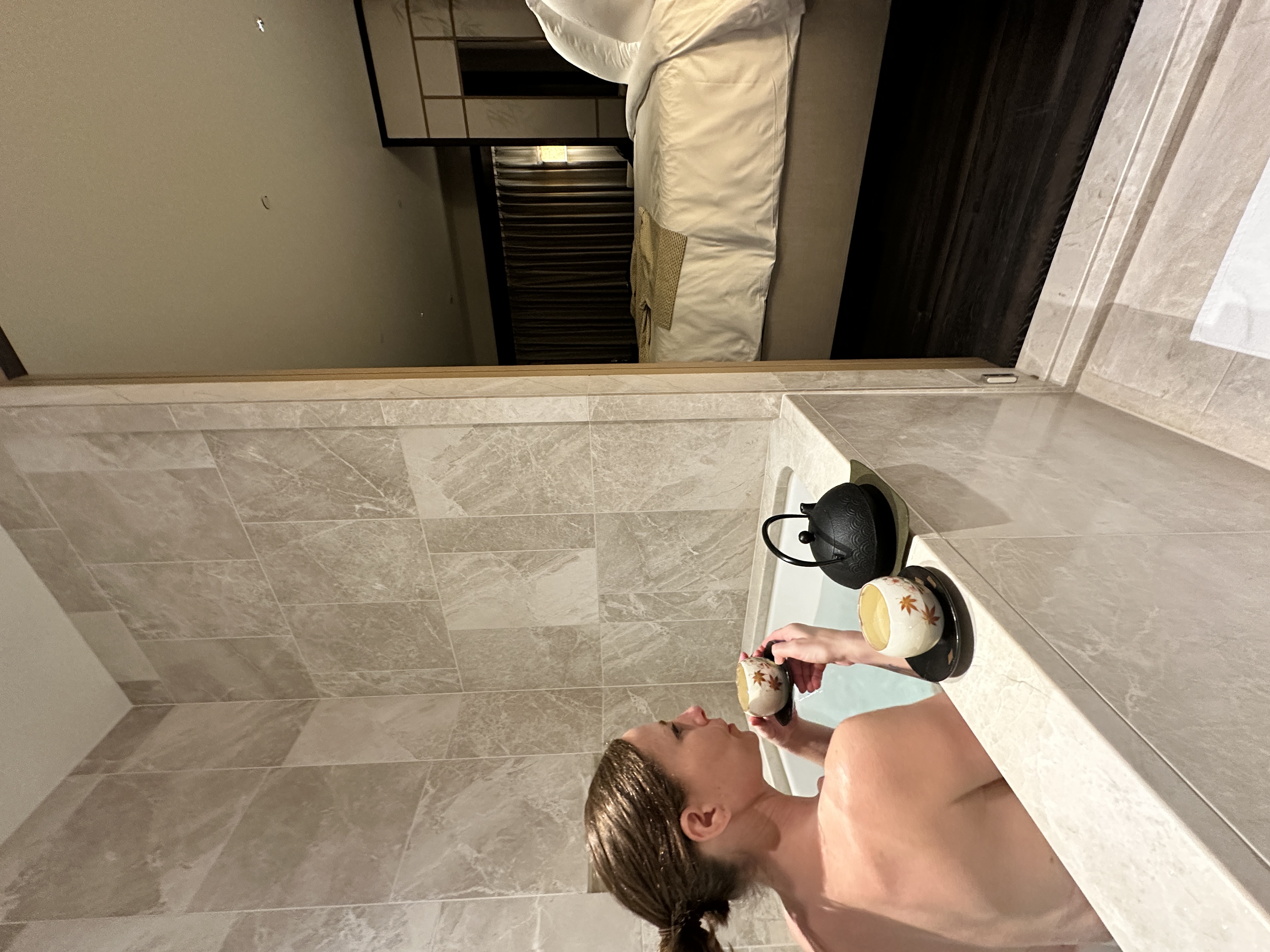
Tea in the tub. No notes.
I drew a bath and brewed some herbal tea before slipping into the most delicious bed and drifting off to sleep.
Don’t Wear Yukata to Breakfast
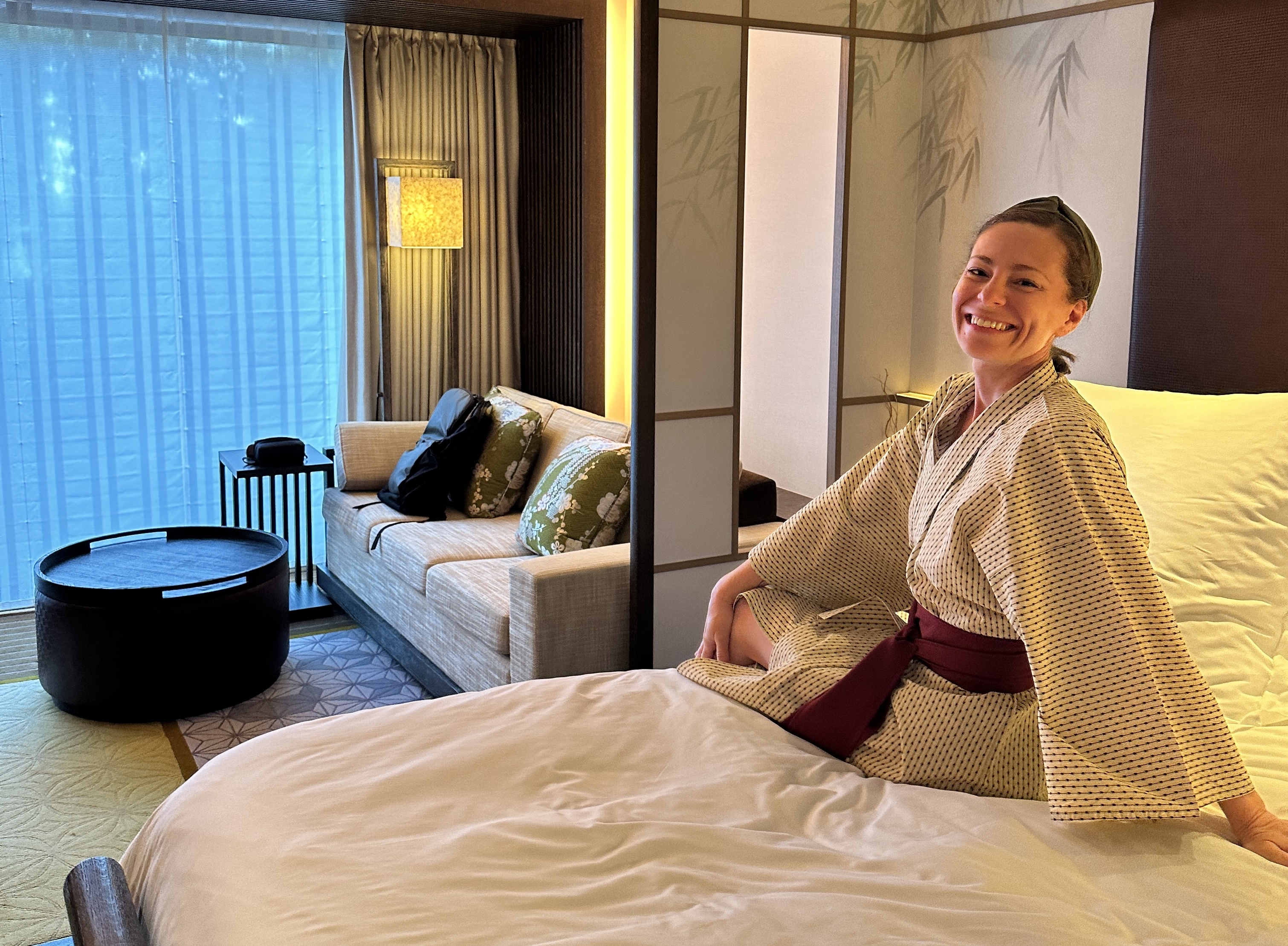
The next morning, I was very excited to put on the yukata they’d left in the room. I’d seen people wear them to breakfast at ryokans and I thought, why not? It’s beautiful. I’m in Kyoto. Let’s do this.
Israel looked at me. “You’re wearing that to breakfast?”
“Yeah, why not?”
I strolled into the restaurant feeling very immersed in the culture. The hostess’ greeted me with a warm smile.
“You look so lovely in yukata!” And they seemed almost heartbroken when one of them so sweetly said, “I’m so sorry, ma’am, yukata is not allowed at breakfast.”
My cheeks turned pink but we bowed and smiled enough to quickly wash away any embarrassment. I understood. Of course they’d want to protect something this precious. I happily walked back to my room and changed.
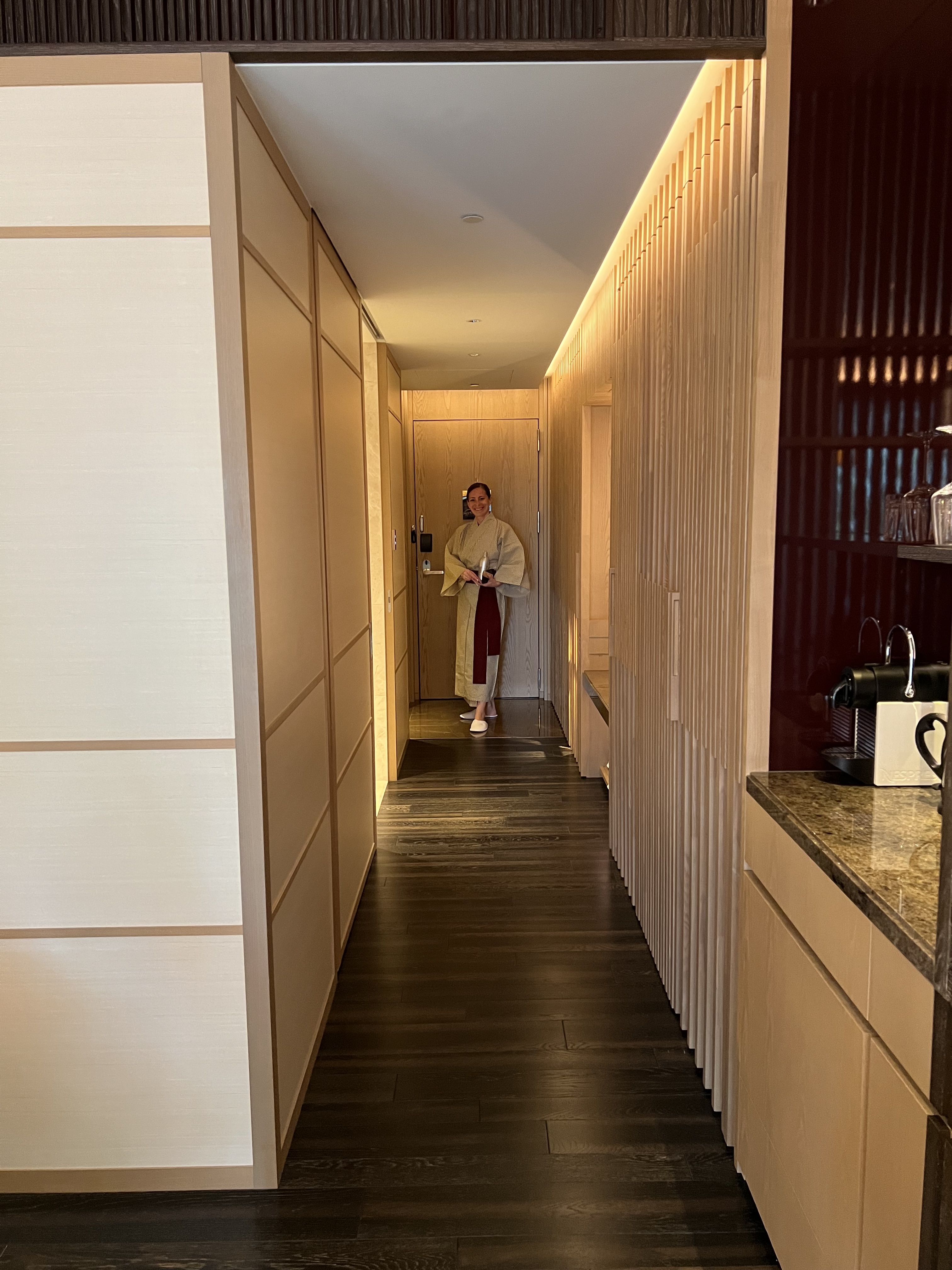
Too bad, I was made for yukata.
I later learned that you can wear yukata in your room, and to the spa. And after breakfast, that’s exactly what I did.
The Breakfast
Breakfast at Four Seasons Kyoto is set up like an invitation.
There’s a full Western buffet with breads, cereals, omelets, and fruit. And then there’s a separate section with all the elements of a traditional Japanese breakfast: grilled fish, miso soup, pickled vegetables, rice. You can build your own experience.
I dove head first into the Japanese breakfast section. Some miso, some fish, and we ordered the fluffy pancakes! They weren’t the viral jiggly kind, but still really good. Israel got the eggs and sausages.
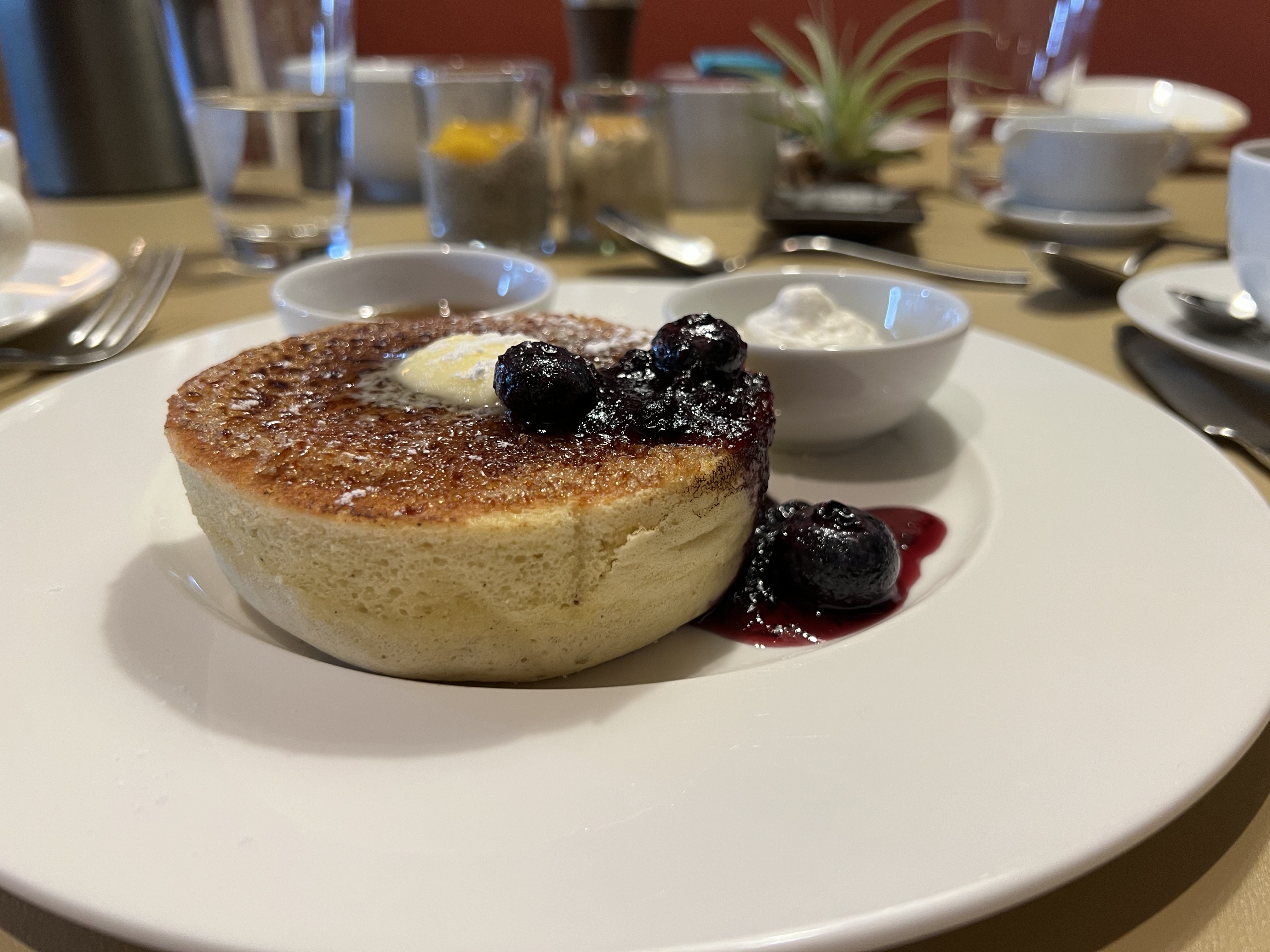
The fluffy pancakes were a nice surprise.
We sat in one of the bird’s nest nooks, circular seating areas that kind of hug you while you look out at the garden. It was cozy and private.
I kept thinking about that word: invitation. Everything here was like that. They weren’t forcing you into an authentic Japanese experience. They were saying: here’s the culture, here’s what we love about it, try it if you like. No pressure.
The Ofuro
Before I get into it, a heads up: the ofuro is communal. Gender-separated, but communal. And there are no swimsuits here, you go in naked.
Lucky for me, I had completed my initiation in Tokyo.
What I loved most about this spa was the journey. You’re slowly guided into each step and that makes it easy for you to know exactly what to do.
Past the spa desk, through a door, I saw a long corridor. A quick right led me to the locker room. A bit further and I was at the toilets and sinks. Just a bit more and I found the private showers. The walls were dark stone, everything sleek and quiet. I felt my shoulders start to drop for the first time in days. I walked past the relaxation area, and at the end of the path; the baths. Hot volcanic stone bath, cold plunge, sauna, and public showers.
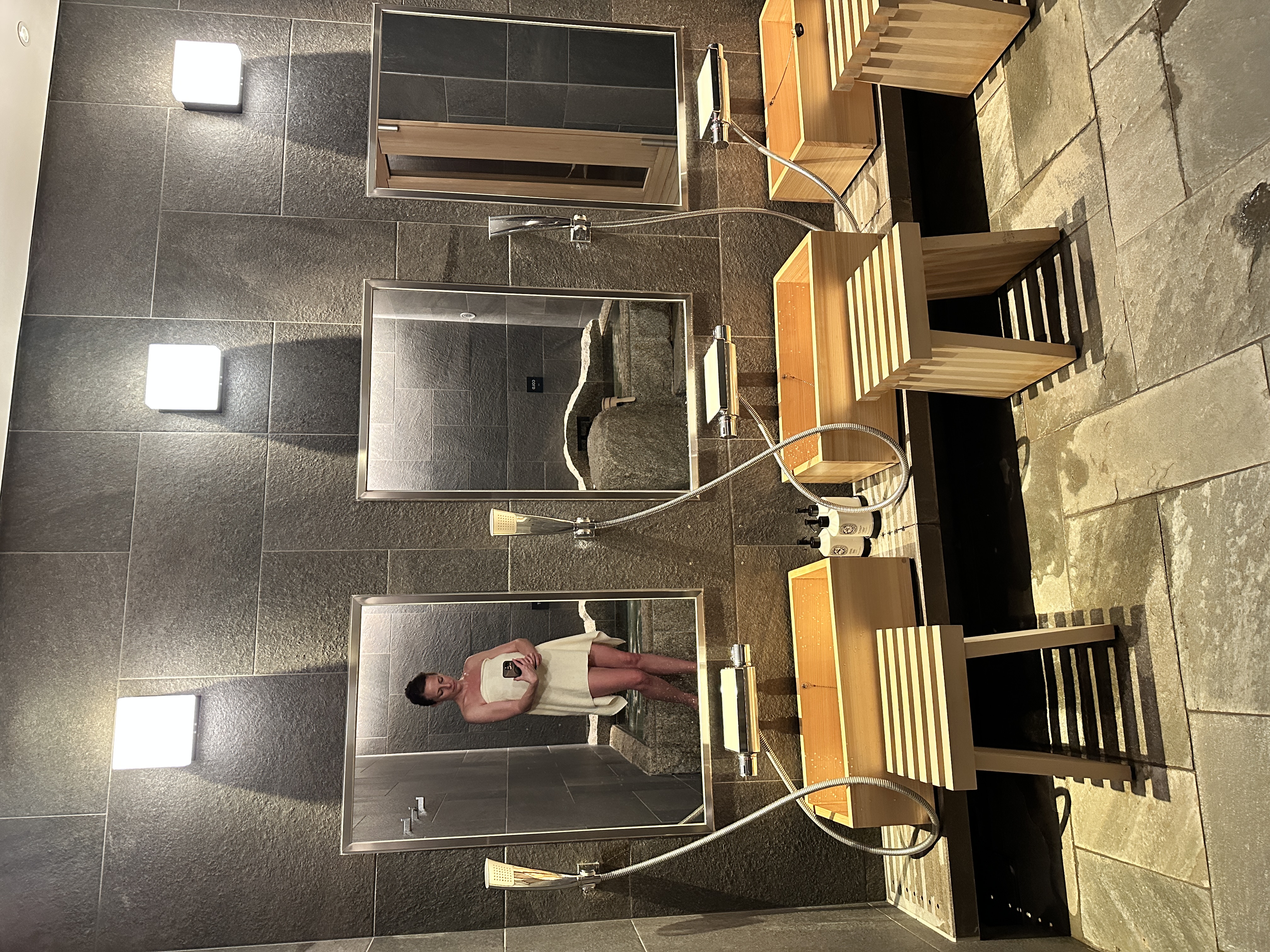
My happy place.
I had the space all to myself so I went through the whole sequence without rushing. After I’d had my fill, I grabbed a cold towel and water from the fridge and headed to the relaxation area. I stayed there longer than I planned. The low lighting, the sounds, and the luxurious canopied cubbies had a way of making you want to stay and just be still for a little longer.
Worth knowing: you can change or shower in the open areas or in a private room. Your choice. This hotel will always give you the choice.
I walked out of there feeling brand new and ready for life. Can I just stay here forever?
The Garden Walk & The Shrine
We almost left without doing it.
Our bags were all packed and we were ready for the next part of the journey. And then we looked at each other and remembered: the ema! We had a couple of hours before our car arrived, so we went.
The garden had been watching us through every window since we arrived but walking through it was different.
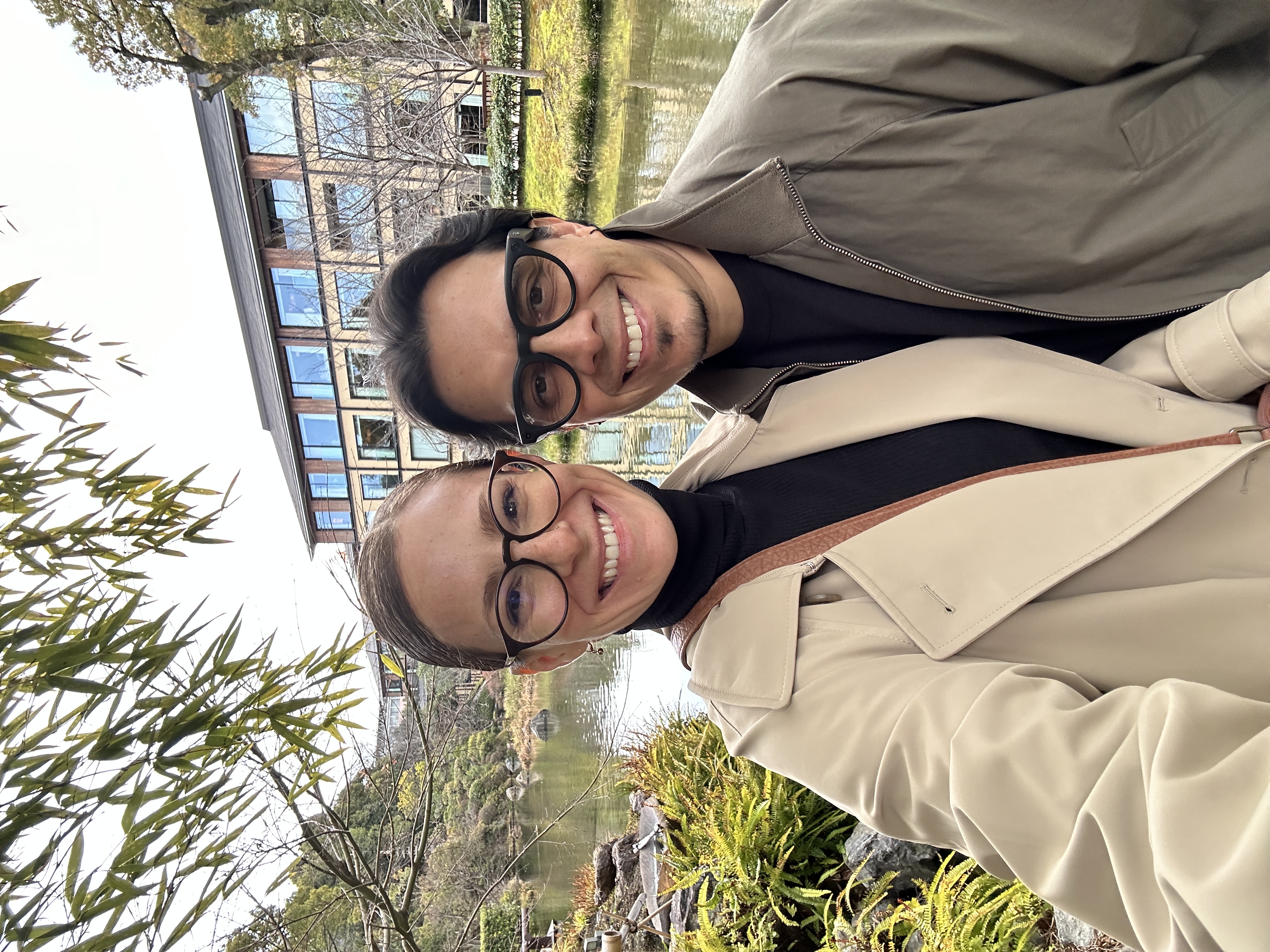
We are cuter in Kyoto.
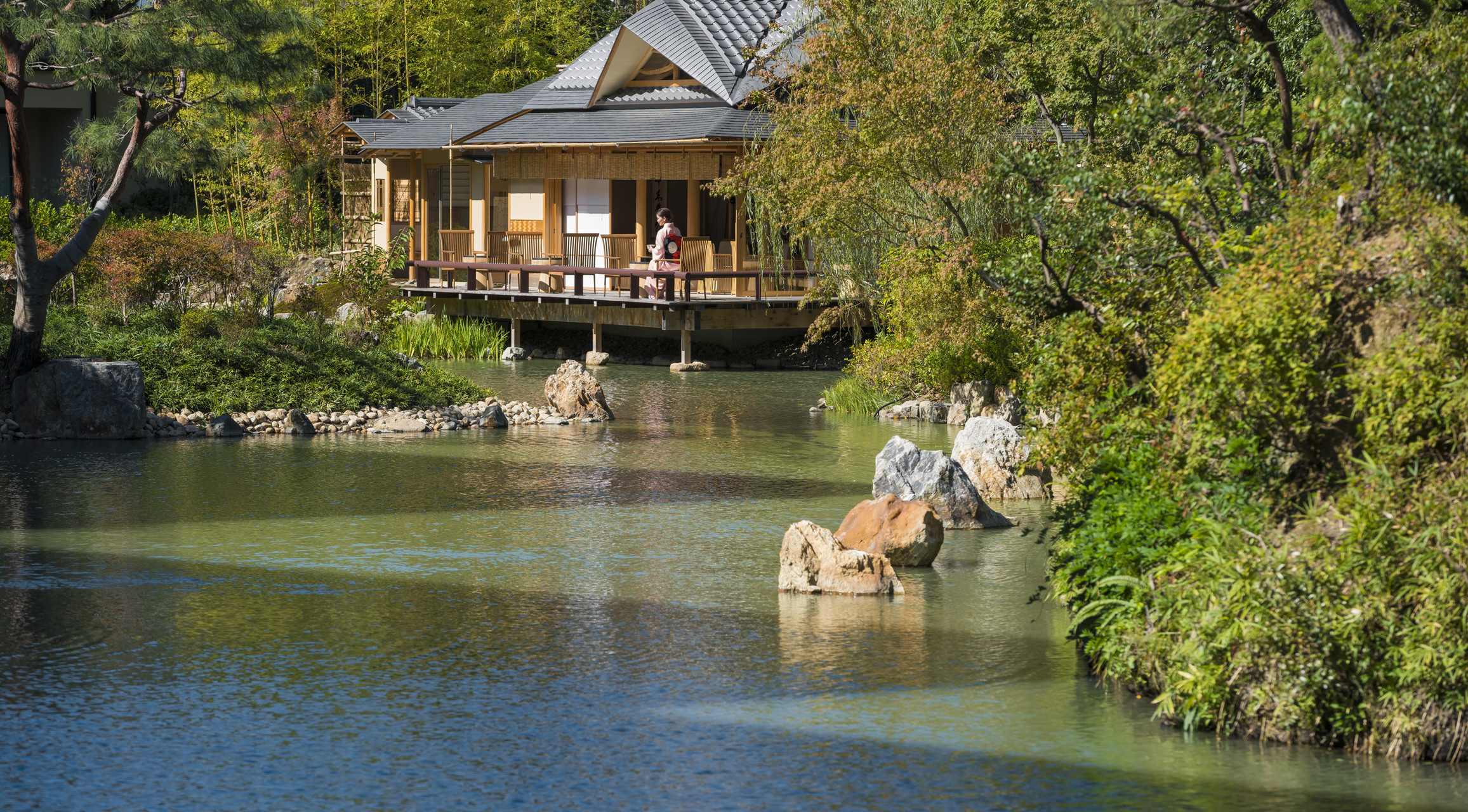
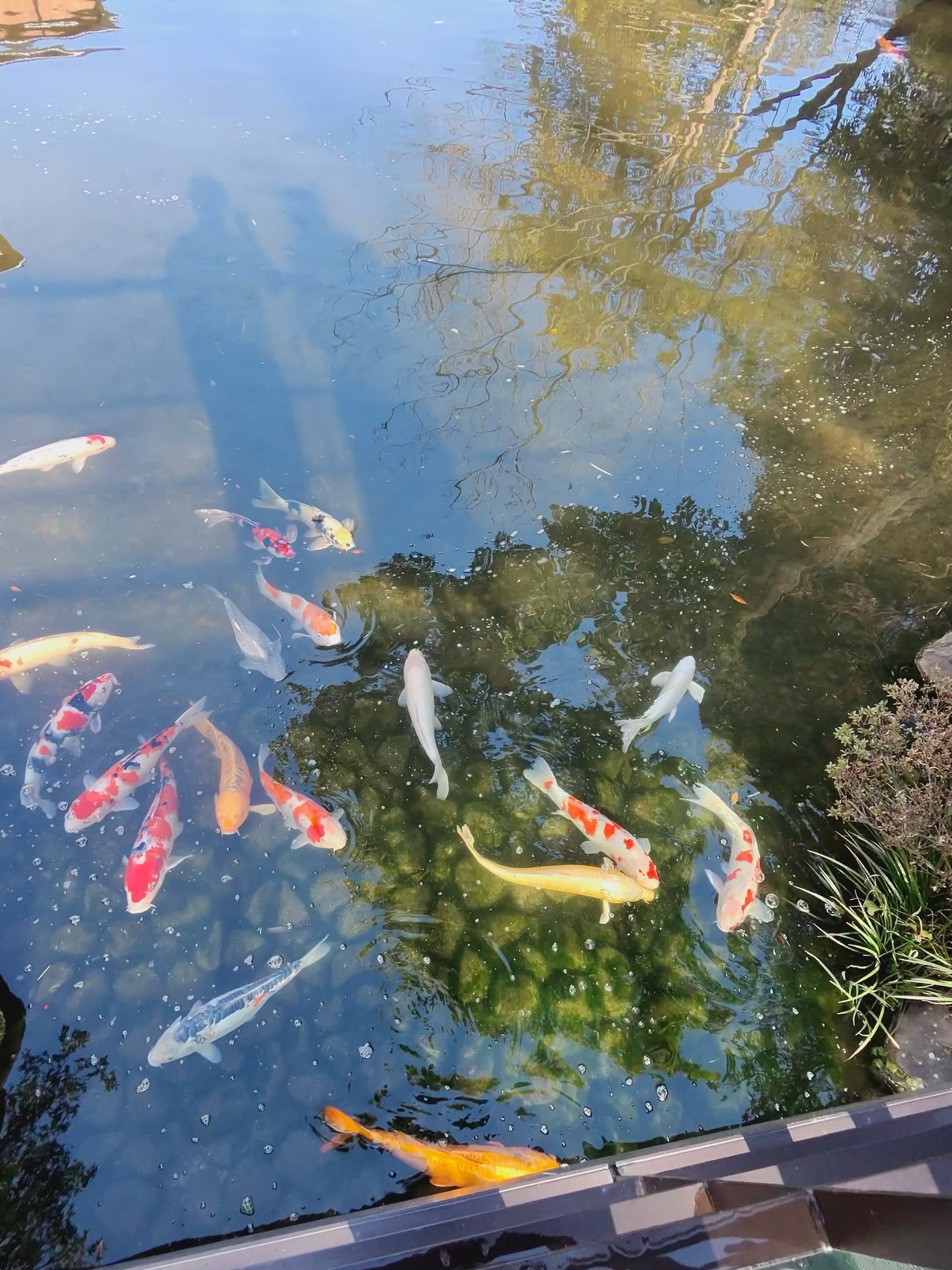
The Shakusui-en is a 12th-century ikeniwa, a traditional Heian-era pond garden dating back to 1138.[5] It’s believed to have been the private estate garden of Shigemori Taira, eldest son of the military leader Taira no Kiyomori, and it is referenced in the Tale of the Heike, one of the great epics of Japanese literature.[15] The 800-year-old pond was full of koi, gold, white, orange, red, moving slowly, unbothered. Mandarin ducks floated near the edge. The air smelled like wet earth and moss. The Four Seasons gave us the cutest little packets of food to feed them, and they all came closer to say hello.
We crossed the stone bridge that separated the two ponds. We saw the 100-year-old pagoda on the small island. The Jizo statue (guardian deity of travelers and children), watching over everything. Tucked nearby, the Sukiya-style tea house designed by local architect Ryosuke Yamamoto, two spaces inside: Fuju, a lounge for tea and sake, and Shakusui-tei, a private room for the formal tea ceremony.[5, 6]
And then we walked up the hill, away from the water, through the trees, to the shrine. It was hidden and felt like a secret, like it was there just for us to find.
That’s where it all came together for me.
The shrine where we wrote our wishes.
We’d been carrying the ema since we checked in. They gave it to us that first afternoon, same table, same tea, same matcha cookies, a small wooden plaque and the quiet understanding that you’d find the moment for it yourself.
Climbing the hill through the trees, I understood why they give it to you at the beginning. This hotel doesn’t manufacture a moment. It lays out the pieces and trusts you to find your own meaning in them.
Now we’re back at the beginning, here on the bench. Those tears came before I even registered them. Not sadness. Pure, uncomplicated gratitude: for all of it, for how quietly it had accumulated, for the fact that I hadn’t seen it coming.
I’m writing this from home now, weeks later, and I still think about that bench by the shrine. The way the light came through the trees. The weight of the ema in my hands before I hung it up. Four Seasons Kyoto is a bridge. Western comfort meets Kyoto culture. And you get to choose how far across you want to walk. I don’t know if my wish will come true but I walked into that property a traveler and I left as someone who had been genuinely seen. Some hotels give you a beautiful room. This one gave us something to carry home.
Krystal’s Rating & Accolades
| Category | Rating | Notes |
|---|---|---|
| Accommodations | ★★★★★ | Premier Heritage Garden Room. Best toilet in Japan. Royally organic. |
| Dining | ★★★★☆ | Snow crab with cheese foam. Beef tenderloin. Breakfast as invitation. |
| Service | ★★★★★ | Cord wrappers. A maiko cloth for my glasses. Notes everywhere. Never felt more seen. |
| Spa & Wellness | ★★★★☆ | Hot stone bath, cold plunge, sauna. Go in order. |
| Sense of Place | ★★★★★ | 800-year-old pond. A shrine. Koi, mandarin ducks, a pagoda. |
| Value | ★★★★☆ | From ~ ¥150,000/night (~$1,000 USD). Heritage Garden Room commands a premium. |
Overall: ★★★★★ Landmark. Four Seasons Kyoto pays attention. And in today’s world, where most would agree attention the highest form of currency, that is worth more than gold.
How to Book
When you book Four Seasons Kyoto through me as a Four Seasons Preferred Partner, you get benefits you can’t access booking direct:
- Priority room upgrades (often confirmed at booking or upon arrival)
- Full daily breakfast for two in the restaurant or via room service
- $100 USD credit for the spa or dining
- Early check-in and late checkout when available
- VIP welcome amenities (better than standard)
- My firsthand intel on which room to request and what to skip
I work with Four Seasons Preferred Partner, Rosewood Elite, Belmond Bellini Club, IHG Destined, and other luxury programs. If Four Seasons Kyoto is part of a bigger Japan itinerary, I’ll make sure every piece connects.
Ready to book? Message me and I’ll take care of you.
Who It’s For
This hotel is for:
- Couples who want romance, seclusion, and an 800-year-old garden as a backdrop
- Americans and international travelers who want to feel Kyoto’s culture without language barrier or overwhelm
- Families: they have a kids’ club, age-specific activities, and 2-3-4 bedroom residences with full kitchens (one even has tatami flooring)
- Anyone who craves genuine care, not service performed as a job, but the kind where someone noticed your glasses on the table and quietly did something about it
This hotel is NOT for:
- People seeking a traditional ryokan experience: full kaiseki in your room, rigid cultural immersion, deep silence of old Japan. This isn’t it.
- Travelers who want to practice Japanese; the team here is international by design
- Budget-conscious travelers (rooms start around ¥150,000/night, roughly $1,000 USD)
When to Go
Best times:
- Late March–Mid April for cherry blossom season (the garden in bloom is extraordinary)
- November for autumn foliage; the Higashiyama mountains turn gold and red and the garden transforms
- January–February for lowest rates and the garden to yourself. Cold outside, but the ofuro feels that much better
Avoid:
- Golden Week (early May): intense crowds, near-impossible availability
- New Year period: same situation
How long to stay: Three nights is the sweet spot. Two gives you a taste. Three lets you settle in: time for the spa, multiple breakfasts, a long morning walk through the garden when no one else is around, and that last morning by the shrine you won’t want to rush.
If you’re doing a longer Kyoto trip, consider splitting: three nights here, three nights at a traditional ryokan. Two sides of Kyoto.
Book 6–9 months ahead for peak season.
What’s Included
Included with your stay:
- Welcome amenities (matcha treats, seasonal fruit)
- Yukata and slippers (for room and spa use)
- Daily housekeeping and turndown service
- Complimentary minibar snacks and non-alcoholic beverages
- Access to spa facilities (ofuro, pool, sauna)
- Cultural programming and kids’ club activities
Not included:
- Breakfast (unless booked through Preferred Partner or included in rate)
- Spa treatments and massages
- Dining and alcohol
- Airport transfers
What You Need to Know
Location: Higashiyama-ku district, Kyoto
- 5-minute walk to Sanjusangendo Temple
- 12-minute walk to Kiyomizu-dera Temple
- 18–20 minute walk to Gion (or 5-minute taxi)
- 8-minute taxi from Kyoto Station (~¥1,200)
- 90 minutes from Kansai International Airport by car or train
The Property:
- 180 keys total (110 rooms, 13 suites, 57 residences)
- Sushi Ginza Onodera (omakase with 400-year-old hinoki counter)
- EMBA Kyoto Grill (where we had that incredible beef)
- Fuju Tea House (matcha, sake, mocktails)
- SEY Bar (opening April 2026 — cocktails and Japanese whisky)
- 3,000-square-foot spa with ofuro, pool, sauna, steam room
- 800-year-old Shakusui-en pond garden
- Shrine with ema for writing wishes
- Tea house for private ceremonies
- Butler box for discreet laundry and shoeshine service
- In-room iPads for checkout and concierge chat
- The best toilet I’ve encountered in Japan (yes, really)
The Property:
- 180 keys total (110 rooms, 13 suites, 57 residences)
- Sushi Ginza Onodera (omakase with 400-year-old hinoki counter)
- EMBA Kyoto Grill (where we had that beef tenderloin I’m still thinking about)
- Fuju Tea House, Sukiya-style tea house by local architect Ryosuke Yamamoto; Fuju lounge for tea and sake, Shakusui-tei private room for formal tea ceremony
- SEY Bar (opening April 2026, cocktails and Japanese whisky)
- 3,000-square-foot spa with ofuro, pool, sauna, steam room
- 800-year-old Shakusui-en pond garden
- Shrine with ema for writing wishes
- Shakusui-tei private tea ceremony room
- Butler box for discreet laundry and shoeshine service
- In-room iPads for checkout and concierge chat
- The best toilet I’ve encountered in Japan (yes, really)
Resources
The Property
- [1] Four Seasons Hotel Kyoto — Official site for current rates, room categories, dining, and spa programming
- [2] Four Seasons Kyoto — Facts & Press Room — Official property specs, key counts, and operational details
- [3] Rooms & Suites — Full overview of room categories including the Premier Heritage Garden Room and residential suites
- [4] Services & Amenities — Spa, ofuro, pool, butler box, concierge services, and more
- [5] The Shakusui-en Garden — Official page on the 800-year-old pond garden, its history, and wildlife
- [6] Shakusui-tei Tea Ceremony — Private tea ceremony room bookings
- [7] Family & Kids Programming — The Playroom, kids’ camping, koi feeding, and family dining details
- [8] Getting Here — Transport from Kyoto Station, Kansai Airport, and Osaka
Dining
- [9] All Dining at Four Seasons Kyoto — Full restaurant, lounge, and in-room dining overview
- [10] Sushi Ginza Onodera — On-property omakase; reservations required and book out well in advance
- [11] Sushi Ginza Onodera — Omakase Course Menu — Current seasonal menu and pricing
- [12] Fuju Tea House Menu — Tea, sake, and the Kyoto Tonic mocktail
Architecture & Design
- [13] MG2 Architecture — Four Seasons Kyoto — The architectural firm behind the property’s historic preservation and modern integration
- [14] Hirsch Bedner Associates (HBA) — Interior design firm responsible for the subtle elegance aesthetic
Cultural & Historical Context
- [15] The Tale of the Heike — 13th-century Japanese epic referencing the Shakusui-en estate; English translation by Royall Tyler (Penguin Classics, 2012)
- [16] Japan National Tourism Organization — Official cultural reference for ema traditions, ofuro etiquette, yukata customs, and seasonal travel planning
- [17] Japan Guide — Higashiyama — Non-commercial neighborhood guide for temple distances, walking routes, and seasonal timing